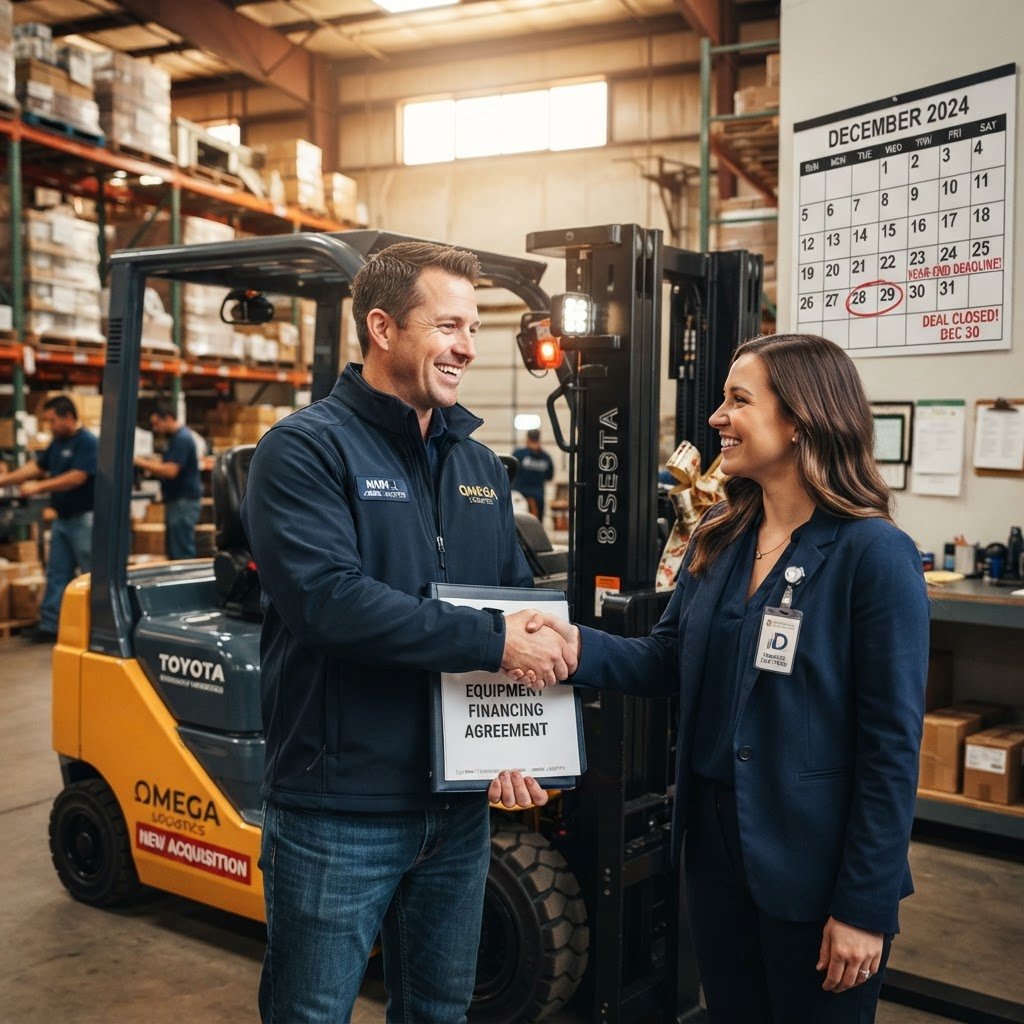
Why Understanding Equipment Financing Rates Matters
Every business owner who walks into an equipment financing conversation wants to know one thing: what is my rate going to be? It is a fair question, and it deserves a thorough answer. At Equipment Finance Academy, we believe that Arizona businesses make better financing decisions when they understand how rates are calculated, what factors they can control, and what the rate actually means in the context of the total deal.
The truth is that no lender pulls a rate out of thin air. Equipment financing rates are built from a series of factors, each adding to or reducing the rate from a base level. Understanding these factors empowers Mesa, Phoenix, and Tucson business owners to position themselves for the best possible terms and to evaluate financing offers with confidence.
The Foundation: Benchmark Rates
Where Rates Start
Every equipment financing rate begins with a benchmark rate. This is the baseline cost of money in the economy, and it is set by market forces and the Federal Reserve. The most common benchmarks that affect equipment financing rates include the Federal Funds Rate, the Prime Rate, Treasury yields, and SOFR (Secured Overnight Financing Rate).
The Federal Funds Rate is the rate at which banks lend to each other overnight. While you never pay the Federal Funds Rate directly, it influences every other rate in the economy. When the Fed raises or lowers this rate, equipment financing rates eventually move in the same direction, though not always at the same pace or by the same amount.
The Prime Rate is typically the Federal Funds Rate plus 3 percent. Many equipment lenders use Prime as their starting point, adding a margin based on the specific deal characteristics. As of early 2026, the Prime Rate sits at approximately 7.5 percent, reflecting the Fed's gradual easing from the 2022 to 2023 tightening cycle.
Why Lender Rates Do Not Move in Lockstep with the Fed
When the Federal Reserve cuts rates by 50 basis points, equipment financing rates do not instantly drop by 50 basis points. Lenders adjust more slowly, cautiously, and incrementally than the Fed because their cost of funds, risk models, and competitive positioning all factor into the equation. A 50 basis point Fed cut might translate to a 25 basis point reduction in equipment financing rates over a period of weeks or months.
This lag effect means that Mesa, Phoenix, and Tucson businesses should not wait for rate cuts to begin their equipment financing process. The rate you get today reflects current market conditions, and rates can move in either direction regardless of Fed announcements.
Factor 1: Your Credit Profile
Personal Credit Scores
For small and medium-sized businesses, the personal credit score of the business owner or guarantor is one of the most significant factors affecting the financing rate. Lenders use credit scores as a proxy for reliability and repayment likelihood. Higher scores signal lower risk, which translates directly to lower rates.
Here is a general framework for how credit scores affect equipment financing rates for Arizona businesses:
Excellent credit (750 and above) qualifies for the best available rates, typically in the range of Prime plus 1 to 3 percent. Good credit (700 to 749) qualifies for competitive rates, usually Prime plus 2 to 5 percent. Fair credit (650 to 699) qualifies for standard rates, typically Prime plus 4 to 8 percent. Below-average credit (600 to 649) qualifies for higher rates reflecting increased risk, often Prime plus 8 to 12 percent. Challenged credit (below 600) may still qualify through Equipment Finance Academy but at rates that reflect the elevated risk profile.
Equipment Finance Academy works with credit scores as low as 550, though rates and terms will vary significantly across this spectrum. If your credit score is lower than you would like, our account representatives can advise you on steps to improve it before applying, or help you find the best available terms at your current score level.
Business Credit and Financial History
Beyond personal credit, lenders evaluate the financial health of the business itself. Time in business, annual revenue, profitability trends, existing debt obligations, and industry-specific risk factors all influence the rate. A Phoenix business with five years of profitable operations, strong revenue, and minimal debt will qualify for significantly better rates than a startup with no track record, even if the owners' personal credit scores are identical.
Factor 2: Collateral and Equipment Type
How Collateral Affects Your Rate
Equipment financing is secured lending, meaning the equipment itself serves as collateral for the loan. The type, condition, and resale value of the equipment directly impact your rate because they determine how much the lender can recover if the loan defaults.
Equipment with strong resale markets commands better rates. A late-model CAT excavator or a John Deere tractor has an active secondary market, meaning the lender knows it can recover a significant portion of the loan balance by repossessing and selling the equipment. This liquidity reduces lender risk and lowers your rate.
Highly specialized or custom equipment with limited resale appeal represents higher risk for the lender because recovery in a default scenario is more difficult and uncertain. This risk premium translates to higher rates. Similarly, older equipment with lower residual values may carry slightly higher rates than newer equipment.
New vs. Used Equipment
New equipment typically qualifies for the best rates because it has the longest useful life remaining and the highest residual value. Used equipment rates are usually slightly higher, reflecting the shorter remaining life and lower collateral value. However, Equipment Finance Academy places no age restrictions on used equipment, and the rate difference between new and used is often modest, typically 1 to 2 percentage points.
For Mesa, Phoenix, and Tucson businesses considering used equipment, the slightly higher rate on a used machine is almost always offset by the substantially lower purchase price. A used excavator at $150,000 with a 10 percent rate may cost less per month than a new excavator at $300,000 with an 8 percent rate.
Factor 3: Loan Structure and Terms
Loan Amount
Very small loan amounts (under $25,000) may carry slightly higher rates because the fixed administrative costs of originating, documenting, and servicing the loan represent a larger percentage of the total transaction. Larger loans spread these costs over a bigger base, which can result in better rates.
Equipment Finance Academy finances equipment from $10,000 to $5,000,000, with the most competitive rates typically available on transactions of $50,000 and above.
Loan Term Length
Longer loan terms generally carry higher rates than shorter terms. This is because the lender's money is at risk for a longer period, and longer time horizons introduce more uncertainty about the borrower's financial condition and the equipment's value. A 36-month term will typically carry a lower rate than a 72-month term on the same equipment.
However, shorter terms mean higher monthly payments. The optimal term length balances a competitive rate with a monthly payment that fits comfortably within your cash flow. Equipment Finance Academy account representatives help Arizona businesses find this balance for every transaction.
Down Payment
A larger down payment reduces the lender's risk because the borrower has more equity in the equipment from day one. This reduced risk often translates to a lower rate. A 20 percent down payment may qualify for a rate that is 1 to 2 percentage points lower than a zero-down or 10 percent down scenario.
Equipment Finance Academy offers programs with down payments as low as zero for qualified borrowers, but putting more down when you can afford it is a proven strategy for securing better rates.
Factor 4: Industry and Intended Use
Industry Risk Profiles
Lenders evaluate industry risk when setting rates. Industries with historically low default rates and stable demand, such as medical, dental, and professional services, often qualify for the best rates. Industries with higher volatility or seasonal cash flow patterns, such as construction, agriculture, or oil and gas, may see slightly higher rates reflecting the cyclical risk.
Equipment Finance Academy has deep experience across dozens of industries and understands the specific risk dynamics of each sector. Our knowledge of Arizona's economy, including the booming construction market in the Phoenix metro, the agricultural sector in southern Arizona, and the growing healthcare industry statewide, helps us match our clients with lending programs optimized for their industry.
How the Equipment Will Be Used
Lenders also consider how the equipment will be used. Equipment that generates direct, measurable revenue (a dump truck on a construction site, a CNC machine in a manufacturing shop) is viewed more favorably than equipment that supports operations indirectly (office furniture, general-purpose vehicles). Revenue-generating equipment has a clearer pathway to repayment, which reduces perceived risk and can improve your rate.
Factor 5: The Lender's Cost of Funds and Overhead
What It Costs Lenders to Lend
Lenders are businesses too, and their rates must cover their costs. These include the cost of the capital they lend (their own borrowing costs or investor return requirements), operational overhead (staff, technology, office expenses), default and collection costs (the inevitable losses when some borrowers do not repay), and profit margin (the return their business model requires).
Different types of lenders have different cost structures. Banks often have lower costs of capital because they can use depositor funds, but they have higher overhead and regulatory compliance costs. Non-bank lenders may have higher capital costs but lower overhead and faster processes. Equipment Finance Academy works with a network of lending partners to find the combination that delivers the best rate and terms for each Arizona client.
How to Get the Best Equipment Financing Rate
Improve Your Credit Before Applying
If you are not in a rush to acquire equipment, spending three to six months improving your credit score can pay dividends in lower rates. Pay down existing balances, correct any errors on your credit report, and avoid opening new credit accounts before your equipment financing application.
Prepare Complete Financial Documentation
Incomplete applications slow down the process and can result in higher rates because the lender compensates for the uncertainty with a risk premium. Mesa, Phoenix, and Tucson businesses that provide complete financials, tax returns, bank statements, and equipment documentation upfront signal credibility and make it easier for the lender to offer competitive terms.
Consider a Larger Down Payment
Putting 15 to 20 percent down instead of the minimum can reduce your rate by 1 to 2 percentage points. Over a 60-month term on a $200,000 financing, a 2 percentage point rate reduction saves approximately $12,000 in total interest.
Work with an Equipment Finance Specialist
General-purpose banks and brokers may not have access to the same range of equipment-specific lending programs as a dedicated equipment finance company. Equipment Finance Academy's lending network includes programs specifically designed for different equipment types, industries, and borrower profiles. This specialization often results in better rates than a one-size-fits-all approach.
The Rate Is Not Everything
Total Cost and Terms Matter More
Many Arizona business owners fixate on the interest rate and overlook factors that can be equally or more important. Prepayment penalties, documentation fees, origination fees, late payment penalties, and restrictive covenants can add thousands of dollars to the total cost of financing even when the stated rate looks attractive.
A 6 percent rate with a 3 percent origination fee, a prepayment penalty, and a blanket lien on your business assets may cost more and restrict your business more than an 8 percent rate with no fees, no prepayment penalty, and a lien limited to the financed equipment. Equipment Finance Academy provides transparent financing with no hidden fees, so the rate you see is the rate you pay.
Apply for Equipment Financing Today
Understanding how rates work is the first step toward securing the best equipment financing terms for your Mesa, Phoenix, or Tucson business. The second step is working with a financing partner who has access to competitive programs, transparent terms, and deep industry knowledge.
Apply for equipment financing through Equipment Finance Academy and receive a decision within 24 to 48 hours. Or contact our team to discuss your specific situation and learn what rate and terms you can expect. Knowledge is power, and now that you understand how rates are built, you are ready to negotiate from a position of strength.
Equipment Finance Academy
Equipment financing specialist with years of experience helping businesses acquire the equipment they need to grow and succeed.